Pages

Thursday, 2 December 2021

Deconstructing Utzon

I have based my entry on Sydney Opera House, designed the Danish architect Jørn Utzon.

Deconstructing Utzon (16" by 16")

Uh, I struggled here, not because of the subject, which I found fascinating - but because of the limited timescale I had set for myself, silly me. For most of the challenges, I have liked what I have done. Not this one, it looks more like cheap bling, than the elegant piece I had in mind. Now if I had not been in last minute, I could have started all over, and done something I could be proud of. Well you win some, you loose some.


Wholecloth quilt (silk/cotton fabric - never again!), fused silks, limited quilting and self coloured binding.

Detail

Deconstructivist architecture is characterised by surface manipulation, fragmentation, and non-rectilinear shapes which distort and dislocate architectural conventions concerning structure and envelope

In 1957, Utzon unexpectedly won the competition to design the Sydney Opera House. His submission was one of 233 designs from 32 countries, many of them from the most famous architects of the time. Although he had won six other architectural competitions previously, the Opera House was his first non-domestic project. One of the judges, Eero Saarinen, described it as "genius" and declared he could not endorse any other choice.

The designs Utzon submitted were little more than preliminary drawings. Dr. Emory Kemp's consulting career began at Ove Arup, where, he conducted analytical calculations for the roof, noting this was no simple task, as Utzon’s sketches were designed to embellish the beauty of the international landmark, not necessarily for simple mathematics. (from Wikipedia).


Contrary to popular belief the design is not based on sails, but on a ball shape, starting with a peeled orange.

Starting with an orange


Utzon's Drawing


Under construction 

Bring on the next challenge!


The next Challenge is ......


As the 2nd December has arrived and I have to choose the next subject I thought it best to do it as soon as possible so that we can all get going on our pieces and if you are in a bit of a lull after the New Year this will get you going.  I had this subject in my mind at the beginning of our series we are currently in and have waited with bated breath every month as to whether someone else would choose what I wanted as my subject.  So the next Architect, Designer, Painter, Mosaic artist I have chosen is:

GAUDI

His architecture is astounding, his colours are so bright and bold, his designs are so out of the box I trust you will enjoy every moment of our next challenge.

In September our local Guild invited Paul Schutte to run a two day master class on Gaudi's Mosaics.  Having visited Barcelona he came home and designed and produced some wonderful pieces and is at present teaching them here in South Africa.  He is a former South African Quilter's Guild President, is a SAQG Master Quilter and has won a Best on Show in Traditional, Innovative and Art categories at the SA National Quilt Festivals along with many other awards. His work has received recognition and won awards and been seen around the world.  He is also a member of Fibreworks Art and SAQA .  He is a well respected teacher, lecturer, quilt judge and the SAQG Judging Supervisor.  I absolutely loved this class and share my piece that I produced from this class which is below.


Wednesday, 1 December 2021

HELP!

Hi, I was hoping someone could help me. The blog posts come up as gibberish on my laptop. I don't know how to fix this. Any suggestions? You can see below what it looks like. Thanks Amanda

Let's chat!


I was inspired by Frank Owen Gehry's Easy Edges -Wiggle Side Chair (1972) for this project.


In terms of fabric selection, I chose the unique Japanese fabric, 先染め布(saki some nuno). This fabric is characterized by its unique texture and gradation of colors.

The texture of the fabric represents the material of the chair (fiberboard), and the specially cut color represents the change of light and shadow of the chair.


The composition of two chairs facing each other looks like two family members/ friends having a happy conversation. It is a metaphor for the post-epidemic life nowadays.

The distance between each other is getting more and more distant, and the simple gathering and chatting has become a thing to be cherished.


I hope that one day we can resume the good old days and talk about life happily!


                                                           MoMo 


Tuesday, 30 November 2021

 Study in Blue

 Deconstructivism – What a word! What a challenge! It took me 2 months to find a picture or composition that I felt I could interpret as a Fibre Artist.


 Once I had my picture and had enlarged it, I traced off the different ‘buildings’ onto cardboard and then onto a thin but firm batting so that I could work each ‘building’ separately and then place them together.


The sky effect eventually ‘gelled’ after the 4th ‘audition’!  I used Oil Pastels and a variegated Japanese thread over the mottled sky.


The ‘definition’ cording thread was Ink – dyed.

The blue Chiffon, here and there, added some ‘bling’ to the buildings.

Had to add a bit of embroidery in the way of grasses against the one building.


Really an interesting challenge – perhaps I will redo the picture in a different colour one day!


Allison


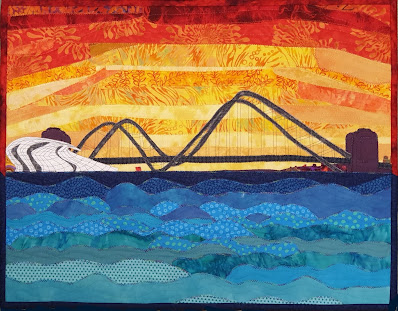
SYDNEY HARBOUR DECONSTRUCTED

SYDNEY HARBOUR DECONSTRUCTED

ARTIST: Nature

______________________________________________________________________________

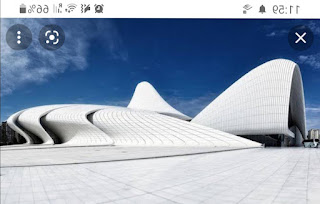
I googled deconstructivism and came across the magnificent Heydar Aliyev Center in Azerbaijan. It immediately made me think of the Sydney Opera House and Sydney Harbour Bridge. One thing led to another and I thought about how climate change - rising temperatures and sea level - might affect Sydney Harbour. 


I flipped the image (which I got off Shutterstock) around to reflect the positioning of the Opera House (the side of the Centre) and the Bridge (the main part of the centre).


So, here we have it, Sydney Harbour caught in the process of being deconstructed by nature - or rather, the shortsightedness of humanity. The Opera House and the Harbour Bridge succumbing to blistering heat melting into the harbour which is, at the same time, rapidly rising to engulf these iconic structures.